
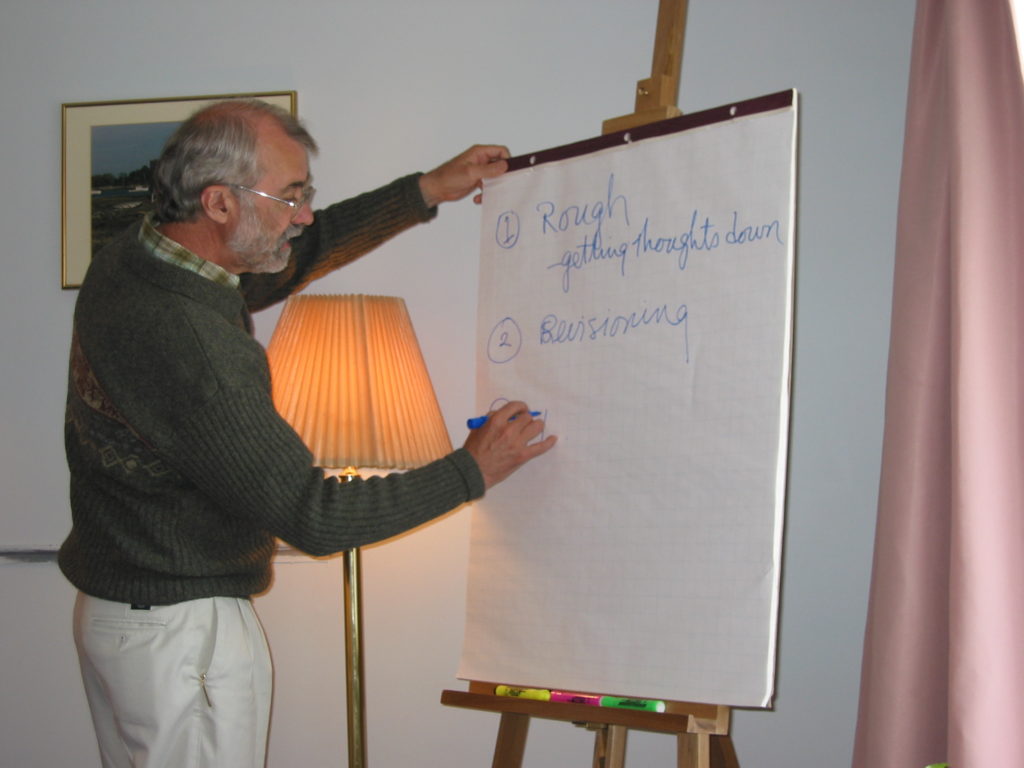
In teaching a memoir workshop, the teacher’s task is to help individuals to go through and beyond two kinds of barriers to their writing: the technical and the psychological blocks that keep them from success. Our job is to facilitate our participants’ arrival at a point where they are able to “own” their stories, to acknowledge their life stories as they are and to accept themselves as they are.
A technical barrier to grasping the meaning of the work might be a writer’s lack of familiarity with using varied or complex sentence structure. A psychological barrier would be a writer’s reluctance to search out and tell the truth of the story, or to identify and sustain the persona in which s/he writes.
It is not easy to deal with these hard issues, to take hold of the moment in the workshop when these points present themselves and to insist that the author and the group deal with them.
But I am always struck by how grateful workshoppers are when we hold them to high standards.
People will say, “I never knew writing was so hard” or, “So this is what writers do. I always wondered what the big deal was–I guess it’s harder than I thought.” Sometimes it’s an “aha!” moment of recognition; other times, the awareness comes quite slowly as writers leave the workshop session and return to the story that challenged them.
The moment of gratitude is often later–after considerable struggle in which the teacher has refused every opportunity to overlook difficulties and has pushed and pushed. It is reassuring to experience, once again, that one’s responsibility is not to “be nice.” A teacher’s job is to do all s/he can to help people to record honest, meaningful, and interesting personal and family stories.
Teaching a Memoir Workshop Is Not Easy
To do that job, the memoir teacher must focus workshops on the present and purposely give stories back to those who lived them. This is not easy; there seems to be an impulse (in every one of us!) to write a smaller, easier version, to let the writer stay comfortable and unchallenged. In fact, it is my experience that most lifewriters are at first content to write smaller stories than the ones they lived. Recently, when I pointed out that there were discrepancies in the emotional tone of a workshopper’s story, she replied quite easily, “Well, no, it didn’t happen that way. I put that ending in because it made it easier to wrap up the story.”
In teaching a memoir workshop, it is the teacher’s task to challenge the impulse to do less, to be less of a writer. It’s the leader’s job to see to it that writers don’t “get away with” writing the smaller, shorter, easier, TV-movie version of their life stories. Rewriting, inevitably, is what allows the story to become larger and deeper, to assume its real size and shape. When we fail to urge our participants towards the fully examined, fully expressed meaning of their stories, we are settling for being less fully realized as teachers and writers ourselves.
When a teacher holds out for the larger, often more complex and difficult story, writers seem–if sometimes only later–to appreciate the effort. This is true leadership in a workshop, for it is only the instructor who can and should affirm his/her authority by saying, “You can do more. Let’s examine how.”
Good luck with your teaching.
No comments yet.