Member Menu

In 1996 and 1997, I composed about 200 pages of a memoir of my high school years and then it wasn’t going anywhere more than where it had been—mired in facts and details with no spirit. What I didn’t know was it had a wrong point of view problem

I merely stored it in various computers for years.

In the fall of 2013, I completed my mother’s memoir (We Were Not Spoiled). Because I was looking for a writing project I might devote myself to next, I picked up the high-school memoir again.

(Lest you think that I went to a high school like yours, let me assure you that I did not. I attended a Catholic high-school seminary. No, I’m not writing about sexual shenanigans—there was none of that whatsoever. I am writing about my life there between 1960 and 1964 and how it shaped me. This theme of identity is usual stuff for a memoir, but the setting is exotic in many ways and not at all usual. Almost none of you who are reading this have “been there”—trust me.)

Suddenly, after more than a decade and a half, the memoir spoke to me again!

“Write me! Write me!” it shouted. The text seemed “alive” again. (more…)

Cindy Doucette (Berwick, Maine) has seen the poignant story of her daughter’s death depicted in It Can Happen To Any Family used by the juvenile correctional system of York County, Maine, to effect turn-arounds in young people. Her memoir has a powerful impact as you will read below. There is power in telling your story! Never forget that. Below is a testimonial written by a young person who was in the correctional system and who is testifying to the influence of Cindy Doucette’s self-published book on her. (The vignette printed here is anonymous to protect the writer.) ~~~~~~~~~~~~~~~~ It Can (more…)

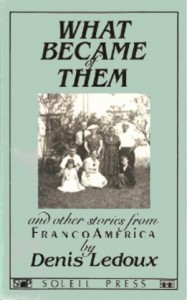
Let me share the independent publication story of my first book, What Became of Them. It is a collection of short stories that I had written over a number of years in the 1980s. In 1987, I decided it was time to send the collection out into the world, but I was not ready yet to do independent publishing.I learn to support myself in the creative life.
Taking stock of myself, I knew I had no need to be approved by someone, to have my writing found to be worthy.  I know many writers want to have a “real book,” and by this, they probably mean they want their book to be canonized by someone—the larger the reputation and the more famous, the better.

This sort of approval was not important to me. I was looking for a way to reach my audience which I knew both existed and would want my book.

I also wanted to earn some income from my writing. I understood that my income would come both from sales of the book and from speaking and teaching from the podium my book would allow me to step up on.

Where to send my manuscript?

I gleaned names and addresses I researched in the library and bookstore. After selecting a few of the more promising—they championed topics which I thought would attract my audience and encompassed a territory where my audience lived.

I sent the book out—and then I waited and waited.

I totally understood how a book has to fit into a publisher’s catalog. (A fruit distributor doesn’t, after all, take on a chicken farmer as a client!) A new book must support the company’s mission and complement books that have already been successful.

In addition, a book must promise to earn the company some income (preferably a large one) from its audience.

A losing proposition

(more…)

The simplest answer to what motivates me to write is that I’ve always loved to write, and lacking the creativity to write fiction or the tenacity to research subjects for non-fiction, I write about what I know, my life. I love memoir.

If I look beyond my lack of creativity, I see writing memoir feeds a certain voyeurism.  I’ve always been fascinated by letters and the glimpse they provide into other people’s lives. I’ve never been able to resist an epistolary book, fiction or non-, and I’ve come to realize that many of the memoir pieces I’ve written are basically letters to myself, or to the family that comes after me.  I love reading letters, so I write them. (more…)

I’ve been reflecting on why I’m motivated to write my memoir and realize that I come back to my writing every day because I cannot stay away. It is how I process life. Writing helps me understand what has happened and how I feel about it. My dad’s Norwegian stoicism and our family’s isolation caused by his alcoholism prevented much communication with anybody, in or out of the family. I turned to writing to “talk” to someone. I wrote letters to any relatives and pen pals who would write back, and who I felt were my friends.

As I now write my memoirs, every memory I write about teaches me something new about myself and how I’ve become the person I am. When I started my memoir, I began to forgive myself for self-defeating behaviors I could not overcome. Re-living events buried for years has brought tears, but it has helped me let go and be a less fearful, ashamed, and workaholic person. Writing is the best thing I do for myself.

(more…)

When Nancy Pelosi sits down to write her memoirs what ought she to do to make the writing interesting? Hint: fame and power in themselves are not enough to intrigue a reader. Here are five memoir writing tips to know.

Writing her memories of her years in Washington will be challenging to Nancy Pelosi but not as hard as some people think. If she is willing to follow the five simple steps I will outline below, she can succeed at writing an interesting and meaningful autobiography. (More and more people—in fact, many who at first think they couldn’t—are succeeding at exploring and honoring their pasts in this way.)

These five memoir writing tips to know are among the most powerful—and easiest—to implement in personal and family history writing.

Good luck—to Nancy Pelosi and to you!

1) Make a Memory List.

(more…)

This is the third in a series of posts on the development of The Memoir Network. In the first and second of the previous posts, I wrote about the beginnings of the Turning Memories Into Memoirs workshops. In this post, I write about how and when The Memoir Network evolved This post will interest memoir writers who wonder how The Memoir Network grew to its present status. Its services—which are necessary both for the success of writers and for The Memoir Network—saw light incrementally over a decade. Memoir Professionals will find the additional attraction of seeing modeled how they, too, (more…)
Editor’s note: In the previous post, I wrote about the birth of the workshop idea. In this post, I write about giving the developing memoir workshop structure. If you missed the first post, go here to read it before going on. (The sequence will enhance your experience.) After my third presentation to her Foster Grandparents, Mary and I wrote a grant to submit to the Maine Humanities Council. It was for three 30-hour workshops at each of the three facilities where I had done my presentation on What Became Of Them, my collection of autobiographical short fiction. The workshops were (more…)

In October of 1988, following upon the publication of my book of short stories, What Became of Them and Other Stories from Franco America, I was asked to read from this collection of autobiographical fiction to a group of foster grandparents. It was to prove how I started to teach memoir workshops.

It seemed good marketing to present to another group of people—potential book buyers. The reading would also give me an opportunity to send in a release to the local newspaper.

I accepted the invitation, but not without some hesitation. Might this group be too small?

Mary, the woman who coordinated the meeting, had told me however that, after my book program, she was confident many people in the room—Franco-Americans themselves— would want to hear the stories and share theirs. At that time, I had no mind to teach a memoir workshop.

(more…)
DoucetteCover

Cindy Doucette’s Memoir Has A Powerful Impact.

Cindy Doucette (Berwick Maine) has seen her poignant story depicted in It Can Happen To Any Family used by the juvenile correctional system of York County, Maine, to effect turn arounds in young people.   Below is a testimonial written by a young person who was in the correctional system and who is testifying to the […]

What motivates me to write

What Motivates Me to Write?

The simplest answer is that I’ve always loved to write, and lacking the creativity to write fiction, or the tenacity to research subjects for non-fiction, I write about what I know… (more…)

The Memoir Network Evolved

How The Memoir Network Evolved

The Memoir Network evolved with thought. Its services—which are necessary for the success of writers and of the Memoir Network—grew regularly over a decade. (more…)